
AI for Conscious Creators
Individually, in a small group, or for your team
A setup session and four two-hour sessions · About nine hours live · Delivered live in English or Spanish

Do you correct its answers more often than you use them?
It is not the AI. It is you, and that is the good news.
AI can only be as good as the clarity you bring to it. Without real clarity about who you are, what you want and how you think, what comes back is that same vagueness, amplified. The reverse holds too, and it is the whole premise of this course.
Most courses teach tricks for using the tool. This one works with the person first, so that when you direct the AI, what comes back is recognisably yours. You will also learn what the tool can do. But always on that foundation.
What this actually is
A setup session of an hour to an hour and a half, then four live sessions of two hours each. Between sessions there are assigned exercises (the longest takes about two hours; the others are shorter) and practice on your own work. That part is not optional: the course rests on what happens between sessions, and that is where most of the value shows up.
During the course there is a WhatsApp channel. If something gets stuck between one session and the next, you ask there and I answer. It is not a token channel: most questions come up while you are working alone, and waiting a week for the next session usually means abandoning the attempt.
Sessions are live and not recorded. You work on your own screen in real time while I move between participants. This is not a course you watch.
The content of each session stays with you in the session materials, in slide format, with the points worth keeping in mind while you work with AI.
Every session except the setup opens with a look back at what you worked on in between: what came out, what did not, what questions remain. It is not a formality. It is where some of the most useful learning appears, because it comes from your real work and not from an example of mine.
The work is live and on real material. In the middle sessions each person works on their own tasks while I sit with that work as it happens. I see where each person gets stuck: where they settle for an answer that does not actually answer, where they do not ask for what they need, where they stop too early. I do not tell you what to say when the AI asks something or gives you something thin. I suggest where to look, and that is different for every person. That difference is what leaves the judgment in the person rather than in a document.
Setup session. We get Claude installed and configured, switch memory on and verify it on your screen rather than taking it for granted, and look at how it works: how the general chat area, projects and the agentic workspace differ. In the second part you tell me about the project you are bringing. The choice matters here: not a convenient example, but something you genuinely care about and, if it is also stuck, even better. You tell me what you want to achieve and where it has stalled. You leave with your first exercise and its explanation.
1 · Seeing yourself clearly. We work through what came out of the first exercise. I teach the three levels of working with AI and Danny Iny's Clarity Cascade. Between this session and the next, you build a portrait of yourself across seven dimensions of self-knowledge (based on Tasha Eurich's research) and write, in your own words rather than Claude's, your protocol for collaborating with AI. That protocol is what makes Claude work with you from then on, and not with an average person: with your tone, your level, your way of thinking and what you expect from a good answer. It is the difference between a generic tool and a collaborator who already knows who they are talking to.
2 · Moving the boundary. We all operate inside limits we cannot see: rules we keep, without noticing, about what seems reasonable to ask for. The observation is Danny Iny's: the limit is rarely in the tool, it is in what occurs to us to ask of it. In the session we work live with a prompt designed to make those limits visible in a task you already do, and from there you see how far you can go without them. AI is central to this: some of those limits would be much harder to see on your own. You leave with an unresolved question of your own, deliberately unresolved.
3 · Daring to ask for more. We train the habit of staying in the conversation past the first plausible answer, which is where almost everyone stops. And with it, the habit of noticing whether what the AI returned really answers what was needed or only looks as if it does, and asking again when it does not. In my experience, this is what makes the most difference to the result. We work live on the real questions and work of the participants, not on a prepared example, and I am beside you while you work on yours.
4 · Independence. Up to now you have worked with prompts I designed. Now you design your own, from scratch, for a task of real weight in your work or in a project of your own. The bar is the prompts you have been using in the course: not a short request, but a constructed instruction, with context, role, quality criteria and output format, the kind you reuse every time that task comes back. I am beside you while you build it, so that the result is a quality prompt and not a draft. You also receive the prompt that guides you through the process, so you can create as many as you want. And we close with the rule that runs through the whole course: if you want to know how to do something with AI, you ask the AI itself, and what you need to know is how to judge whether what it says holds up or only sounds convincing. There is no final assignment. The course ends.
What you leave with
What you have when it ends. Almost all of it you make yourself, in the sessions, with me beside you.
A portrait of how you think. Built across seven dimensions of self-knowledge, from your own answers rather than a template. However well you think you know yourself, things you had never put into words are likely to appear.
A working protocol. The tone, the role, the limits you want Claude to hold with you. Written in your words, so what comes back sounds like you rather than like everyone.
Something you already do, worked through in depth. With the principles behind it made explicit, and a short line to come back to when you drift.
A real question of your own, unresolved, put into words you can work with. We leave it open on purpose. You will know why by the end.
A prompt you designed from scratch, for a task of real weight in your work, and the prompt that helps you create as many as you want.
The course prompts. Eight long prompts I designed for this. They are yours and they do not expire: they are made to be rerun, and in my experience each repetition opens layers that were not yet available the previous time.
The materials from each session, in slide format, with the points worth keeping in mind while you work with AI.
Three closing documents. Eleven points on working with Claude. A collection of short prompts for everyday use. And a guide that gathers all the course prompts, each with a description of what it is for.
And the practice itself: the prompts worked through in the sessions, several of them more than once, most of them live with me beside you.
This course asks something of you, and the part between sessions is not optional. It has a cumulative effect: the more someone practises, the more questions they bring to the next session, and those questions are the best material I can work with. In my experience with earlier editions, the participants who advance most are the ones who tried different things, or who arrive with something that did not quite come out right. I bring everything I have to the sessions and to the WhatsApp channel between them. What happens in the weeks after depends on you.
Who this is for
You already know your own field. You bring judgment about your own work. You can tell a good answer from a merely plausible one in your domain. This matters more than anything technical, and the course actively checks for it.
You have real work that is stuck. Something unresolved you actually care about. Something of your own, real. Not an example invented for the occasion.
Your AI results disappoint you. You correct it constantly. It never quite reaches your level. This is the most common experience among regular users, and it is exactly what the course addresses.
Or AI makes you uneasy and you have been avoiding it. You do not need prior experience, or any understanding of how it works internally. You need to be able to think, notice, and say what matters to you.
Who this is not for
You are looking for the latest tips and tricks. I do teach features, and some tricks, along the way. But they are not the point, and they arrive once you know what you want from them.
You are coming for automation and agents. These belong further along than most people think. Delegating well depends on being able to think with the AI first, at a level most people never reach, and then on bringing your own expertise to bear on what comes back. If they come up during the course, I tell you what I know and teach you to find out the rest by asking the AI itself, but they are not the focus.
You want a system you can copy. You do leave with several things you will use again: the eleven points, the full set of prompts I designed for the course, a collection of short ones, and your own protocol. They work because you built your part of them and you understand why. A set of templates handed to you would not do the same thing, and that is not what this course produces.
You are a company looking for standard corporate training. If you want this for your team, get in touch: I design it starting from the work they actually do, and that begins with a conversation.
Why this course is different
Most people use AI as a task machine: write this, summarise that. It works for one-off problems and falls short when what is at stake is thinking, deciding and creating under real complexity.
Four previous editions showed the same pattern, including among the most capable participants. People give AI almost no real context, they stop at the first plausible answer, and they do not ask for much.
Part of that is a clarity gap: people are not sure what they want. Part of it is that AI's first answers are polished. They sound finished, so stopping there is a perfectly reasonable thing to do if nobody has shown you what becomes available three exchanges later.
And part of it, I think, is habit. With other people we almost never say that an answer missed the point. We rarely ask for more. We make do with what we were given and quietly fill in the gap ourselves, without saying anything. Those habits run so deep that we carry them without noticing into the conversation with AI, where none of them are needed: there is no sensitivity to protect, no need to be brief so as not to take up someone's time, and you can go back and ask again as many times as it takes. Getting past that took me a long time, and a good part of this course is spent on it.
So this course trains something specific: directing an intelligent system from your own judgment, rather than reacting to it or handing over the wheel. That is what I mean by sovereignty. Staying the author of what you are making, using AI to go further in your own direction instead of drifting into its.
Technical tricks change every few months. What does not change is the underlying skill: asking for what you actually need, noticing when an answer falls short, pushing back. Once you have that, you no longer need anyone to teach you the latest feature. You can find out from the AI itself, because you know how to ask.
Where this comes from
This way of working with AI is not something I invented. I learned it from Danny Iny, who developed it and teaches it in live workshops and his book AI Curious. The Clarity Cascade is his. So is the idea that we operate inside invisible limits of what seems reasonable to ask for, and the work of pushing past them. I recommend his book without reservation, and if you want the full version in English, go and take his workshop.
What I do is different in ways that matter for some people. I work with one to six at a time, in Spanish or English, slowly, adapting each session to the specific person in front of me. And I bring something to the self-knowledge half of it that comes from my own field: twenty years inside the research on how people are shaped by things they cannot see, and 350 hours of training in working with what surfaces when someone starts to look.
The self-knowledge work draws on Tasha Eurich's seven pillars. The prompts are mine, in the sense that I wrote every one of them, and they are modelled on Danny's. I learned this method from him, so his prompts are where mine started, built for my own words and a much smaller room. Some of them would feel familiar to anyone who has taken his workshops.
What people who have done it say
From earlier editions of the course. It was substantially redesigned for the current edition. What these describe, which is how the sessions run, has not changed.
About me
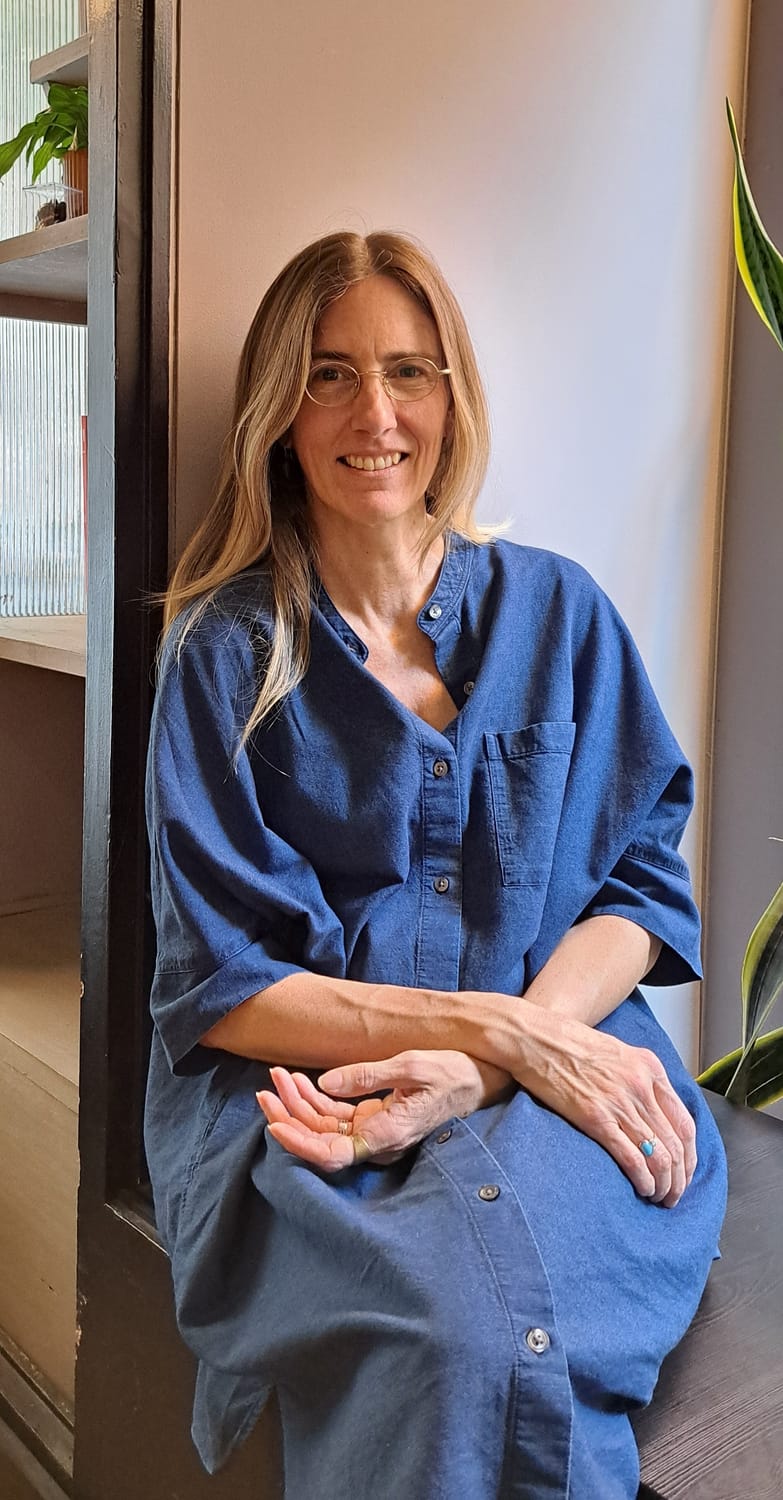
I have spent twenty years coming back to the same question: what actually drives us when we cannot see what is driving us.
I came at it first as an experimental researcher. My PhD is from INSEAD, working on conditioning and nonconscious associative learning. I published in the Journal of Consumer Research and the Journal of Consumer Psychology, where my 2011 lead article received the C.W. Park Award for the best paper published in the journal that year.
Those two decades also showed me where the lab stops: knowing why a pattern forms does not tell you how it shifts. I went on to complete the 350-hour Compassionate Inquiry® Professional Online Training developed by Dr Gabor Maté and Sat Dharam Kaur, and, within the same framework, ten weeks of specialist training in recognising and responding to acute emotional distress.
I am Academic Collaborator in the Marketing Department at Esade Business and Law School (Universitat Ramon Llull), where I teach The Action Gap, an undergraduate elective on why people who know exactly what to do still do not do it.
This course exists because both halves of that background turned out to matter: what I know about how people work, and what I have learned about getting a machine to work with a particular person rather than an average one.
This is the fifth edition of AI for Conscious Creators, so far with individuals and small groups.
What it costs
€900 individual
€450 each for two people
€350 each for three to six, for those registering as individuals. For teams from the same organization, please contact me.
Claude Pro is additional, from $20 a month (the final price and taxes depend on your country; check claude.ai/upgrade), and is paid directly to Anthropic.
The button below is for the individual format. For a pair or a small group, write to me first so we can agree dates, and I will send you the payment link.
For companies, get in touch.
Practical details
Dates. No fixed editions. Get in touch and we will find dates that work, individually, in a pair, in a small group, or for your team.
Format. Live on Zoom, not recorded. Delivered in English or Spanish.
Group size. Up to six, and deliberately smaller when I can. The personalisation is the method rather than a bonus, and it is why smaller groups cost more per person.
You will need: a computer, a stable connection, real unresolved work to bring, and an active Claude Pro subscription.
Why Pro and not the free plan. Not for memory, which works on the free plan too. Two other reasons: searching your previous conversations is only available on paid plans, and this course builds on what Claude already knows about you; and free-plan usage limits are several times lower, which makes the 45 to 90 minute conversation between Session 1 and Session 2 impossible to complete.
Cancellation. You have 14 calendar days from purchase to withdraw, without giving any reason, and I will refund the full amount. After those 14 days, the place is non-refundable, though it can be transferred to someone else by agreement. If you buy less than 14 days before the start and want to begin within that period, I will ask for your express consent to do so; if you withdraw afterwards, you will pay the proportionate part of what has already been delivered.
Questions
No. The course is built for people starting out and for people who already use it daily. What matters is how you think and how you frame a question, not your technical level.
Yes. Most confident users stop at the first plausible answer, and the first plausible answer is almost never the best one available. You will learn to stay in the conversation past that point, to give it enough real context that it can be useful about your situation rather than about situations in general, and to ask for things you did not realise were available to ask for.
This surprises people most. When Claude has spent weeks learning how you think and where you get stuck, the precision can be startling. It does not replace a trusted friend. But as something that holds the whole shape of what you are working on, remembers what you said three weeks ago, and pushes back when you are being vague, it is hard to beat.
Not in the usual sense. The focus is the quality of your thinking and your dialogue with the tool. Technical competence follows from that rather than being the goal.
A Claude Pro subscription, and real work that is stuck. If you do not have Pro yet, we set it up together in the setup session.
No. Everything is live, because the learning is in the practice and the exchange. The content of each session stays with you in the materials. Block the time.